
التشغيلية توظيف مفاهيم المأهولة-من دون طيار كفريق (أمي-T) في أرض الحرب في المستقبل المنظور.
Having previously introduced the swarm-armor integrated armored forces’ manned-unmanned collaborative combat methods and provided an overview of infantry squad and platoon-level manned-unmanned cooperation, we remain uncertain about whether ground unmanned systems can undertake primary assault missions. By analyzing current and potential future technologies, and reflecting on the mainstream approaches to ground operations in modern militaries, we can propose possible organizational structures. Additionally, we can infer potential applications based on anticipated operational environments.
An analysis of the U.S. Army’s operational methods reveals that the operational environments for U.S. ground forces can be categorized into several scenarios. The first involves intelligence gathering on the battlefield environment and security missions. The former refers to U.S. reconnaissance units conducting reconnaissance operations, while the latter entails these units performing tasks such as route reconnaissance, fire reconnaissance, and area reconnaissance. U.S. reconnaissance forces serve as the primary element engaged before the main force enters combat and also play a role in fire direction. In this capacity, reconnaissance units engage in early-stage contact with the enemy, identify enemy dispositions, and prevent enemy reconnaissance of the main force. This constitutes either a reconnaissance-oriented or a diversionary movement to contact. The objective is for the reconnaissance platoon to pin down the enemy while continuously transmitting enemy intelligence to rear commanders. However, at this stage, there may be no follow-on support from the main force acting as an advance guard for the engaged units. Therefore, reconnaissance units require sufficient mobility. From this, we can deduce that reconnaissance units need a flexible and portable unmanned system—one that is neither slow-moving nor logistically complex and can be operated at the company or platoon level. Such a system would not be overly complicated. In this context, the choice for reconnaissance units would likely prioritize reconnaissance drones, supplemented by large numbers of FPV drones or loitering munitions (swarm systems). Ground unmanned systems would primarily serve logistical and obstacle-breaching roles, complemented by an unmanned reconnaissance vehicle for assault purposes. However, U.S. reconnaissance units differ somewhat from those of other nations, as they are also tasked with security missions and certain offensive operations. Consequently, they would typically include a company—whether an armored company or a weapons company—that would inevitably be supported by larger combat unmanned vehicles to provide cover for the forces.
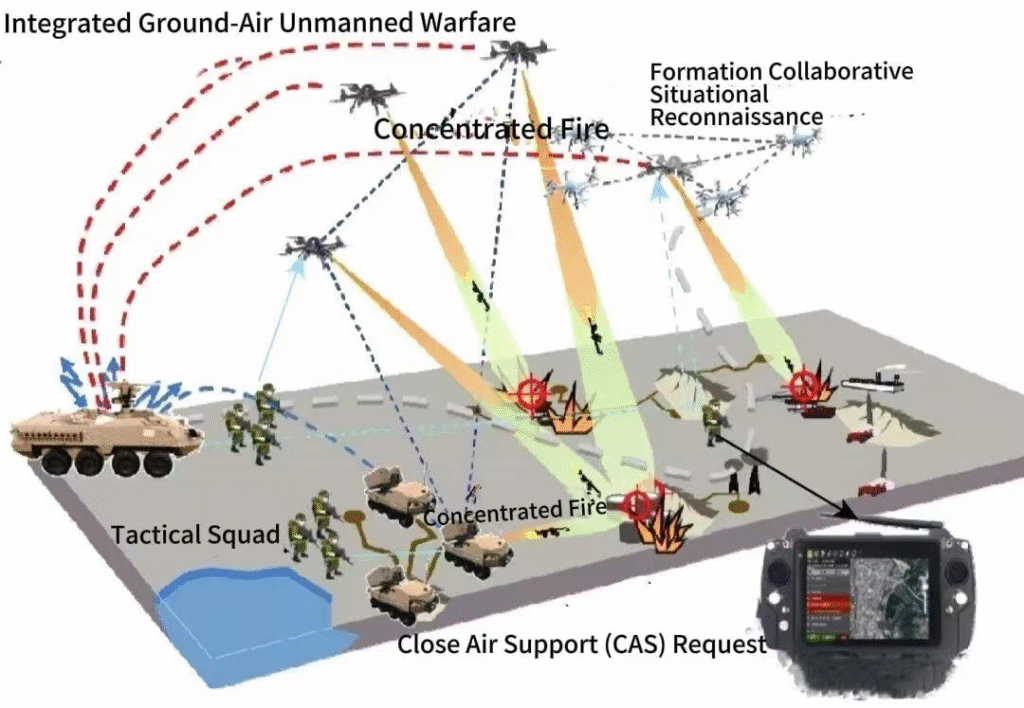
After the main force engages in combat, the focus of operations shifts from reconnaissance units to the combined arms battalion. At this point, the operation enters the rhythm of the combined arms battalion or brigade. Using the combined arms battalion as an example, unlike reconnaissance units, the battalion, as the primary offensive force, follows a sequence of movement to contact, attack, exploitation, and pursuit when conducting independent offensive operations. When executing a movement to contact independently under the brigade’s structure, the combined arms battalion is typically organized into: a reconnaissance and screening element, a vanguard, and the battalion main body. The reconnaissance and screening element operates approximately 10 kilometers ahead of the vanguard company, while the vanguard company moves 5-10 kilometers ahead of the battalion main body. Once the vanguard is engaged, it covers the smooth deployment of the battalion main body. For example, when the vanguard encounters the enemy’s advance elements, it usually rapidly develops the situation, eliminates enemy scouts and ambushes, and marks or clears obstacles for the battalion main body.
In this scenario, the reconnaissance and screening element operates similarly to reconnaissance units, requiring a large number of attack drones (comprising heterogeneous swarms of FPV drones and loitering munitions). Additionally, given that the principle of movement to contact is to engage the enemy with minimal forces, extensive use of suicide drones is the most viable option to ensure lethality and survivability. For ground unmanned systems, a platoon should be equipped with one larger multi-purpose unmanned vehicle, while a squad should be issued smaller ground platforms such as quadruped robotic dogs. However, in such operations, ground forces should prioritize engaging the enemy through aerial firepower.
When the vanguard company makes contact with the enemy, it may encounter small-scale enemy security positions, which are typically composed of extensive fixed and explosive obstacles. In such situations, engineer units should be attached and equipped with obstacle-breaching drones and ground-based breaching vehicles to clear a path for the battalion main body’s advance. For the combat platoons of the vanguard company, a three or two-vehicle unmanned ground system (UGS) platoon could be employed, supported by reconnaissance/relay drones and suicide drones/loitering munitions for offensive operations. This tactic—where one manned combat vehicle controls two to three unmanned combat vehicles—has been validated through research. Control is maintained via aerial relay drones, while offensive drones provide additional combat support. The combat company should focus primarily on fire assault, with unmanned vehicles serving as the main thrust of the attack. They can engage the enemy through swarm attacks or provide cover for manned armored vehicles and dismounted infantry assaults, with the goal of reducing casualties among friendly manned units. When armored infantry dismounts for combat, they can utilize secondary unmanned systems, such as armed robotic dogs, alongside aerial drones, to extend the firepower reach and lethality of dismounted infantry squads. Additionally, each platoon should include logistics-support unmanned vehicles to ensure sustained operations.
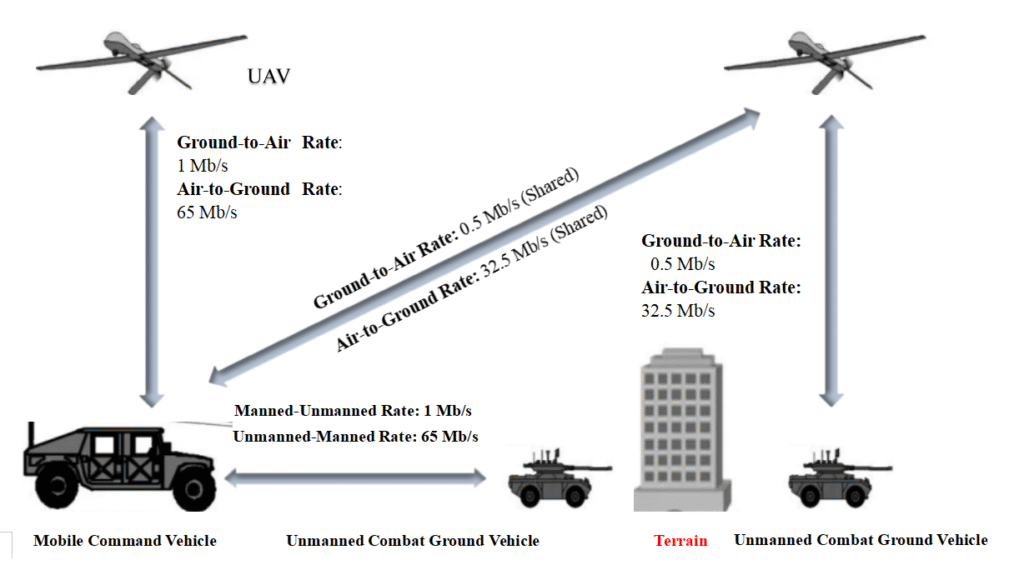
When the main force of the unit conducts an attack, it can be categorized into hasty attacks and deliberate attacks. In such scenarios, unmanned systems should prioritize precision strikes, utilizing drones for reconnaissance, targeting, and fire adjustment. These operations would be supported by field artillery fire and battalion/company-level mortars, coordinated with swarms of suicide drones for assault. The employment of unmanned systems within the combat companies would follow the same principles as previously described for the vanguard company.
In summary, the fundamental logic is as follows: Loitering munitions are used for precision strikes, providing a flexible yet direct means of engagement.
Drones are employed to enhance situational awareness at the tactical edge by serving as elevated observation platforms. Unmanned ground systems are utilized to support mobile battalion and company operations, as well as to directly participate in combat. Among these, combat-oriented unmanned ground systems act as vanguards, supplementing the role of infantry—such as protecting tanks and infantry fighting vehicles—and engaging directly with enemy forces like adversary infantry. Their purpose is to suppress threats posed by enemy infantry to friendly armored vehicles, allowing unmanned systems to assume risks in scenarios where human involvement is unnecessary.
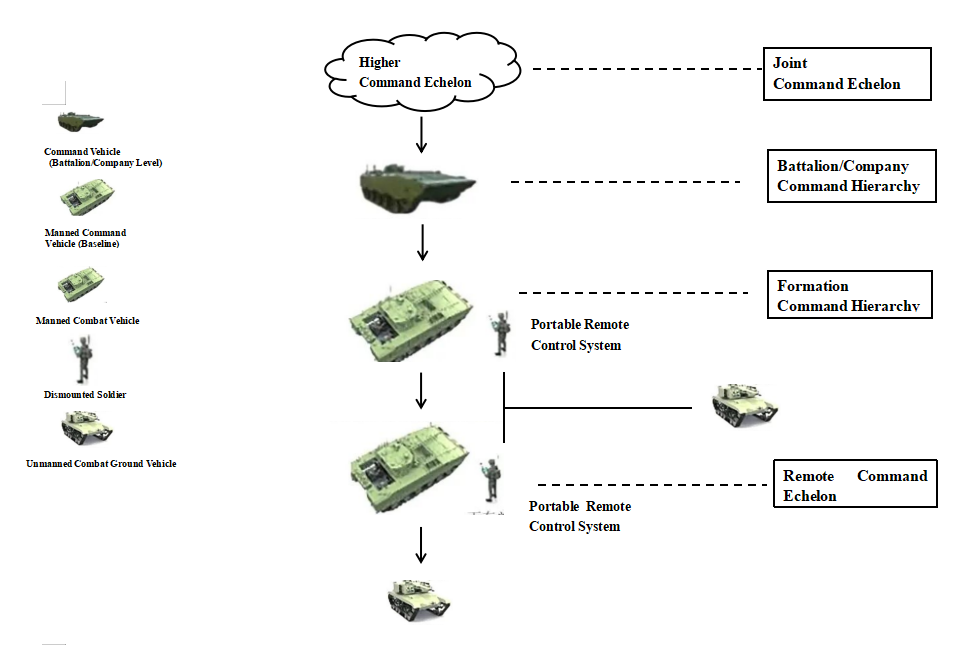
Currently, the combat effectiveness of manned-unmanned teaming surpasses that of independent operations conducted solely by manned or unmanned systems. How to integrate unmanned systems into existing operational procedures based on mission requirements and their unique characteristics is a critical consideration for militaries worldwide. Manned-unmanned teaming will be a defining feature of warfare in the coming years and is expected to become a primary operational method, much like the integration of information and firepower. In the future, conflicts will likely see information-fire integration enabling precision strikes, while manned-unmanned collaboration drives maneuver, penetration, and seizure of key points.